Free reputation management worksheet
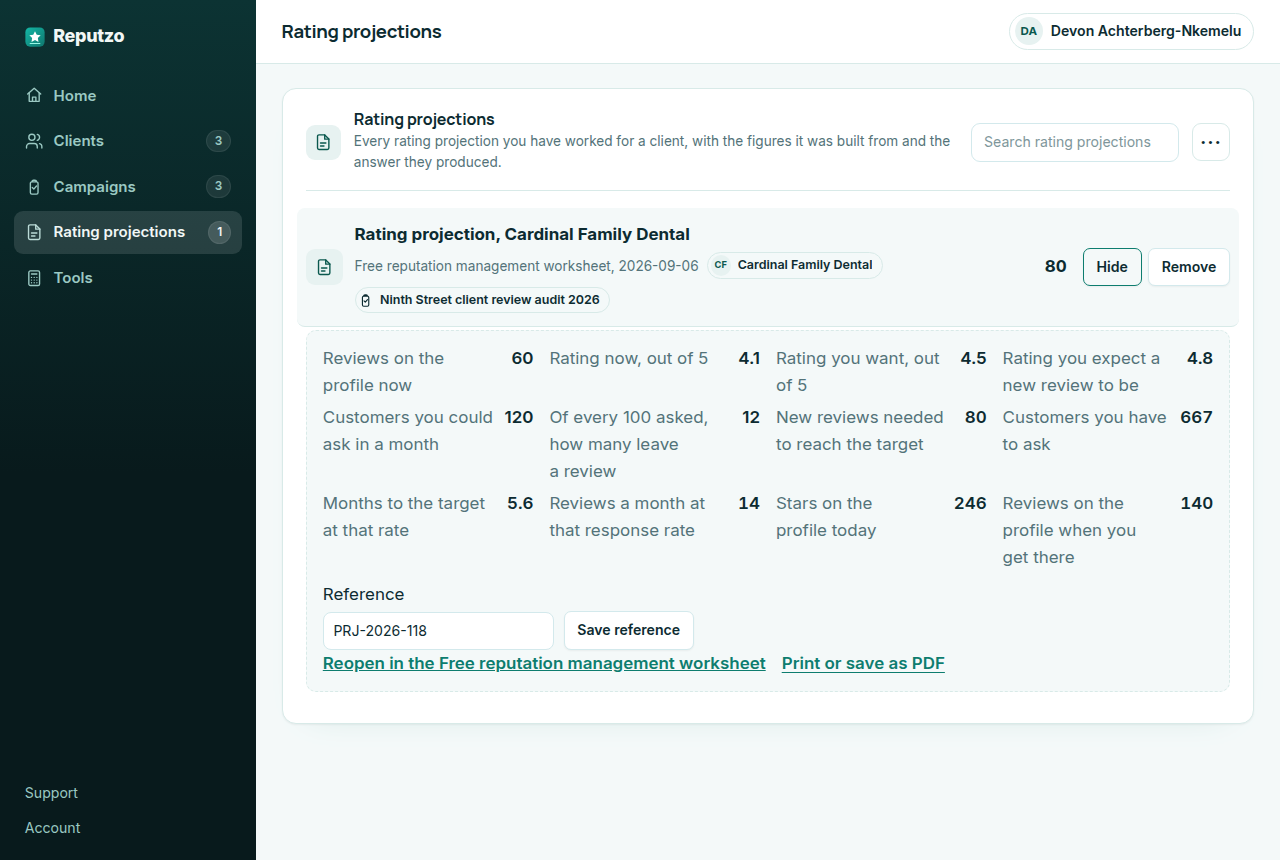
- New reviews needed to reach the target
- 80
- Computed on this page from the inputs below
- Customers you have to ask
- 667
- Computed on this page from the inputs below
- Months to the target at that rate
- 5.6
- Computed on this page from the inputs below
- Reviews a month at that response rate
- 14
- Computed on this page from the inputs below
The worksheet works from your own figures and from the reviews a profile already carries and the rating they average to: a rating is the mean of every review ever left, so a new one moves it by its distance from the current mean divided by the new count. Nothing here quotes a vendor's price except where the page names the vendor, the page it was read from and the day it was read.
Email me this result
We will send you these figures and a link back to them. One email, nothing else unless you tick the box.
The figures above start from a worked example (80), averaged over the reviews a profile already carries and the rating they average to. Change any input and the answer updates as you type.
Download the Free reputation management worksheet worked example (CSV)
Every reputation management prospect asks the same question in the first ten minutes: our rating is 4.1, how long until it is 4.5. This worksheet answers it properly. A rating is the mean of every review ever left, so the reviews already on the profile push back against each new one, and the arithmetic is a weighted average rather than a guess. Put in the current rating and count, the rating you want, what you expect a new review to be worth, the customers you could ask and the share of them who actually leave one, and it gives you the reviews needed, the asks behind them and the months it takes.
Free reputation management worksheet: what agencies ask before they resell it
Why does the answer look so large? Because the existing reviews weigh against every new one. On the worked example, 60 reviews at 4.1 carry 246 stars, and moving the mean to 4.5 with reviews averaging 4.8 takes 80 of them. The more reviews a business already has, the more inertia there is, which is the opposite of what most owners assume.
What response rate should I put in? Yours, if you have measured it. If not, put in something conservative: a well timed text runs far higher than an email a week later, and an optimistic figure is how these projections end up wrong by months rather than weeks.
Should I assume every new review is five stars? No. Even a business people love collects the occasional four, and assuming 5.0 makes the timeline look better than it will be. Something between 4.7 and 4.9 is realistic, and the worksheet is more useful when it is honest.
Where the constants in this tool come from
Reviewshake pricing: the published tiers for review and reputation software.